 Search
  Client Portals
  020 7444 4030

If your life, assets or future plans span more than one country, exchange rates can affect more than you might think. They can influence the cost of everything from overseas property and education fees to retirement income and everyday spending. Holding some assets in the currencies you’re likely to spend can help create greater certainty and reduce unnecessary currency risk, while tax, inheritance and residency considerations remain an important part of the planning process.
Foreign exchange can seem like an everyday practical issue. It becomes far more important when your life, assets or future plans span more than one country.
For internationally mobile people, changes in exchange rates can alter the real cost of long-term commitments. If you expect to spend money in a certain currency, holding some wealth in that currency may help reduce uncertainty.
This isn’t about trying to forecast currency markets. It’s about limiting the need to exchange a large amount of money when the rate happens to be unfavourable.
Start with future spending, not today’s accounts
A useful first step is to map the currencies you’re likely to need in the years ahead. This may give a clearer picture than simply listing where your investments and bank accounts are held now.
Take a UK resident with a home in continental Europe. Their regular costs may include a euro mortgage, local taxes, insurance, utilities and repairs. If every investment is in sterling, the pound value of those bills can rise or fall as the GBP/EUR rate changes.
The same approach can apply to US dollar spending. A family planning for US education fees, a property purchase, business costs or future living expenses may choose to keep part of its assets in dollars. This can help protect the budget if sterling weakens against the dollar.
Long-term movements in GBP/USD show why this matters. If dollar costs rise in sterling terms, an investor with no US dollar assets may need to use more of their sterling wealth to meet the same commitment1.
GBP/USD annual average exchange rate, 2006–2025
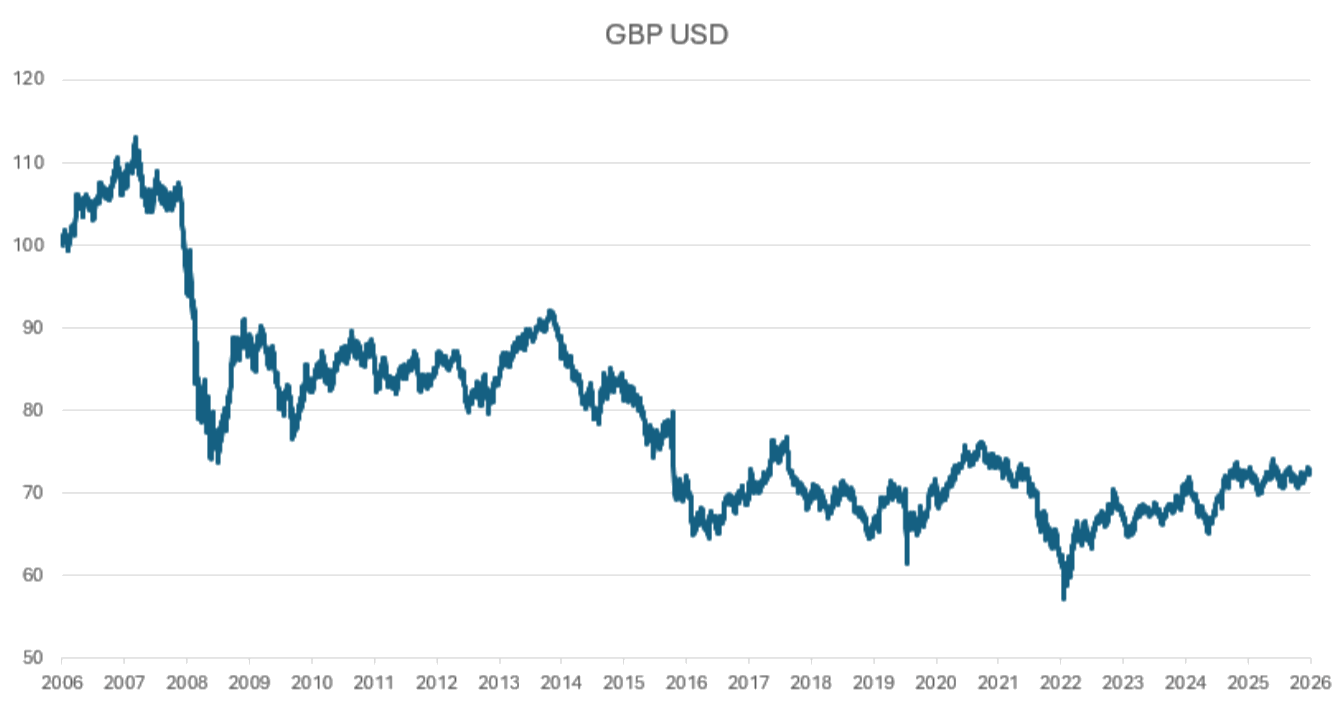
Source: 7IM
The goal isn’t to remove normal investment risk. It’s to create a better match between known spending and the money set aside to pay for it.
Diversification isn’t speculation
Holding more than one currency doesn’t have to mean taking a view on the foreign exchange market. The reason for each holding matters.
For example, an internationally mobile client could hold:
- sterling investments for UK household spending;
- euro assets for the running costs of a European property; and
- US dollar investments for planned expenditure in the United States.
In this situation, the currencies are linked to future liabilities. They aren’t being held simply in the hope of making a gain from exchange-rate movements.
UK tax considerations for recent arrivals
Currency decisions should sit alongside tax planning. From 6 April 2025, the UK remittance basis was replaced by a residence-based approach for income tax and capital gains tax. UK residents are now generally taxed on worldwide income and gains as they arise2.
The Foreign Income and Gains regime, often called the FIG regime, may provide relief for qualifying new UK residents during their first four years of residence. To qualify, they must have been non-UK resident for at least the previous 10 consecutive tax years2.
A successful FIG claim may relieve eligible foreign income and gains from UK tax during the qualifying period. However, making a claim can affect some allowances, so it’s important to consider the person’s wider position2.
The location or currency of an asset doesn’t decide its UK tax treatment on its own. Anyone arriving in the UK with overseas investments or cash should take advice before moving funds or changing how assets are held.
Inheritance Tax and long-term UK residence
The reforms introduced on 6 April 2025 also changed how UK Inheritance Tax may apply to people with international connections3.
Broadly, someone may become a long-term UK resident after being UK resident for at least 10 of the previous 20 tax years. At that point, non-UK assets may come within the scope of UK Inheritance Tax. The rules can also continue for a period after the person leaves the UK, depending on their residence record3.
Because residence history can affect the position, estate planning and currency planning should be considered together rather than as separate exercises.
Reviewing assets held abroad
Some assets need to stay in their original country or currency. When someone changes residence, the key question is whether the structure, tax treatment, liquidity and currency exposure still support the new plan.
For instance, a client with a mortgage in Swiss francs may keep part of their portfolio in CHF. This could reduce repeated conversions from sterling and provide more certainty that money will be available for future mortgage payments.
Currency risk can also sit inside assets that appear cautious. A foreign pension may have a low-risk investment mix, but its value can still move against the currency the client expects to spend in retirement.
Putting the international plan together
When moving to the UK, returning home or leaving for another country, keeping every asset unchanged may look like the simplest option. Sometimes it will be suitable. In other cases, the portfolio may need to change as spending, tax exposure, estate planning and access to cash evolve.
Cashflow modelling can be particularly useful when a plan includes overseas assets or liabilities. It can test how different currency allocations could affect the client’s ability to meet expected costs.
This helps separate practical risk management from an extra, speculative bet on currency markets.
How Partners Wealth Management can help
We advise people who are moving to the UK, returning to the UK or leaving the country to live and work abroad. Our planning can cover overseas property, foreign investments, currency-linked borrowing and future spending in different countries.
Our independent investment service can also help identify investment managers, providers and booking centres that can manage portfolios and lending in currencies such as USD, EUR and CHF, as well as others.
To discuss any of the issues in this article, please contact a member of the International Team, speak to your usual Partners Wealth Management adviser, call 020 7444 4030 or email info@partnerswealthmanagement.co.uk.
Important information: Tax treatment depends on individual circumstances and may change. This article is for general information and isn’t personal financial, legal or tax advice.
Sources
1 Bank of England, Bank of England Database: exchange-rate data for sterling against the US dollar. View official source
2 HM Revenue & Customs, Check if you can claim the 4-year foreign income and gains regime. View official source
3 HM Treasury and HM Revenue & Customs, Reforming the taxation of non-UK domiciled individuals: policy summary. View official source
Sources correct as of 16 September 2026. Official guidance and tax rules may change.


