 Search
  Client Portals
  020 7444 4030

Recent events in Iran and the wider Middle East have added fresh uncertainty to global markets. The images many of us saw over the weekend were deeply concerning, and our thoughts are with those living through the conflict. It’s a reminder that geopolitical events are first and foremost human crises, even as they influence economies and markets.
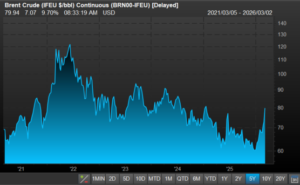
Since the weekend, markets have been reacting to the latest information. Equities have moved lower in the UK, US, Europe and Asia, as a result of initial uncertainty, combined with the worries of higher energy costs. Almost all of Iran’s oil is sold to China. The big move has been in the oil price, which at time of writing, is over $80 dollars a barrel.
While this move has drawn attention, it brings prices back towards their average level over the past five years. The Middle East remains a crucial part of global shipping and energy routes – including the Strait of Hormuz, Iran. Which is why, in part, we’re seeing this reaction in markets, as the tensions have risen. Of course, future price movements are still uncertain.
Source: FactSet
One area we continue to watch is inflation. Higher and sustained energy costs can push inflation up, which may influence central‑bank policy and the behaviour of government bonds.
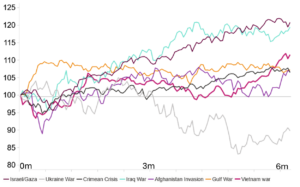
History also provides some useful context. Past conflicts have not always resulted in long‑lasting market declines. In many cases, global markets have stabilised within months. That said, every situation is different, and past performance is not a reliable guide to what happens next.
Source: FactSet. Performance of the MSCI AC World in USD.
If you have questions or would like to discuss the update in more detail, please speak with your PWM adviser. We’re here to support you.
This communication is for general information only and does not constitute advice on investments, taxation, legal matters or any other area. Past performance is not a guide to future results.


